
Headless Shopify development
Control the storefront experience with Hydrogen or your preferred framework while Shopify manages products, inventory, orders and hosted checkout. We handle the engineering, from Headless channel setup and API authorization to edge deployment and GEO validation.

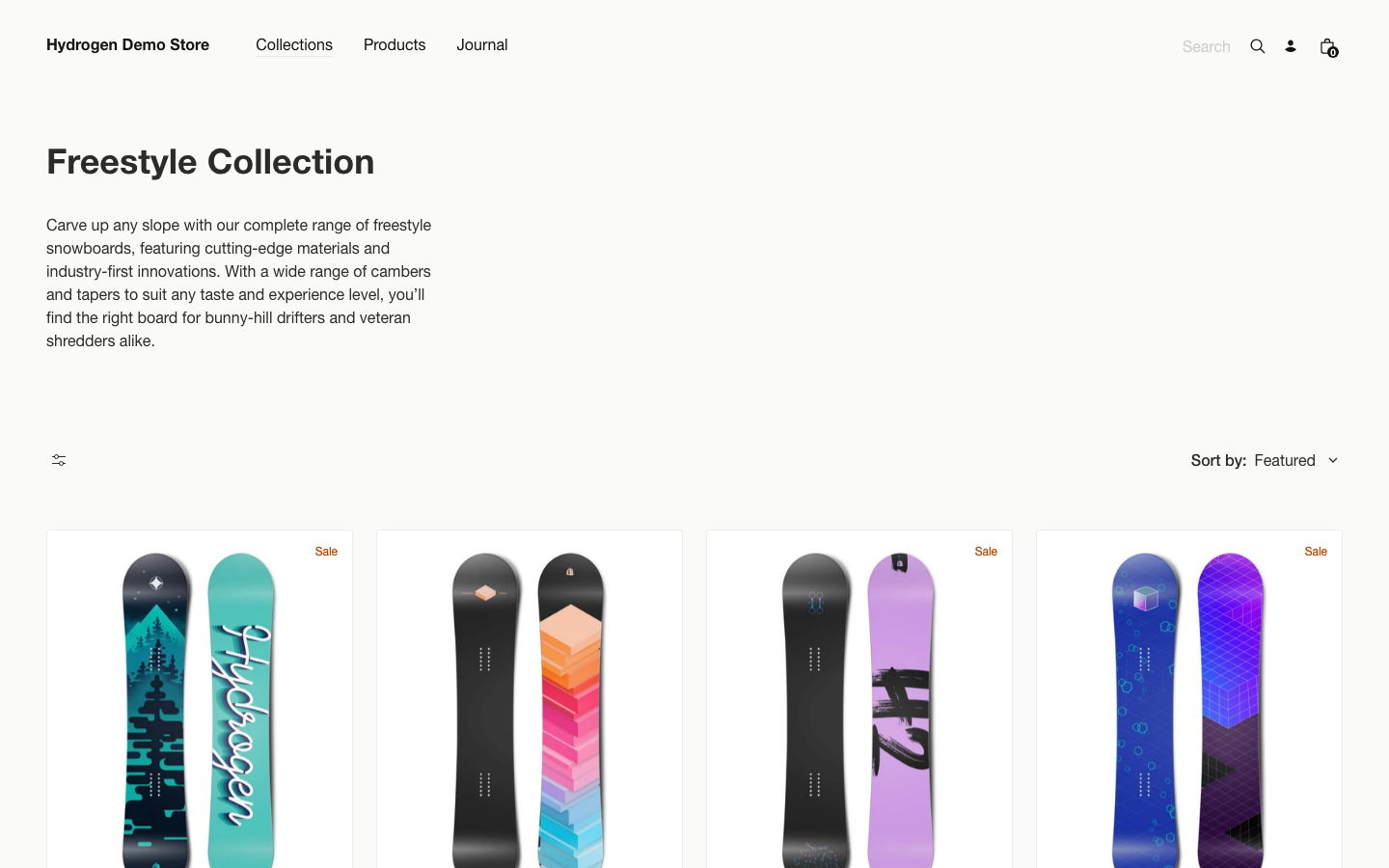
Screenshots from Shopify's official Hydrogen demo store hydrogen.shop , illustrating headless storefront performance and experience. Copyright belongs to Shopify.
Lighthouse performance benchmarks for acceptance
Edge SSR and streaming can improve performance, but architecture alone does not guarantee scores. Lighthouse and Core Web Vitals form part of our acceptance criteria: a Performance score above 90 and scores of 100 for SEO and Best Practices at launch. We continue monitoring real-user data through CrUX to identify regressions.
- Critical rendering path and image/font loading strategy optimization
- Reduce and defer third-party scripts
- Edge caching and CDN acceleration configuration
- Compare Lighthouse results before and after releases
How headless architecture works
The storefront is decoupled from Shopify's backend. A custom frontend renders on global edge infrastructure and uses the Storefront API and Customer Account API to access data. Shopify continues managing products, inventory, orders and checkout.
When headless is the right choice
Headless is not right for every store. We first assess whether themes, apps and Checkout Extensibility can meet your business needs. Our discovery recommendation may be to stay with a theme-based store.
- Custom interactions and brand experiences beyond Liquid theme capabilities
- Content-led brands that tightly integrate content and commerce
- Multiple sites or markets that need a shared frontend architecture
- Demanding performance requirements, including Core Web Vitals and edge SSR
- AI search visibility is a core growth priority
- An engineering team or budget for ongoing technical support
- Standard features meet your needs; themes and apps are faster and more economical
- Critical third-party apps support Liquid themes only
- No ongoing development or maintenance resources
- A limited budget, given headless development and maintenance costs
Shopify describes headless as an implementation model rather than a default requirement. Kotn's co-founder offers a useful benchmark in Shopify's official blog: Shopify covers 80% of the business's needs, while headless addresses the remaining 20%. We apply the same reasoning to your project.
Store setup and authorization in six steps
Shopify's Headless channel is the official route for store authorization. Beyond a basic custom app, it supports multiple storefronts, token rotation, channel-specific product publishing and sales reporting.
| Public Access Token | Private Access Token | |
|---|---|---|
| Where it runs | Browsers and other clients; public exposure is permitted by design | Server only (SSR/BFF); keep the token secret |
| Request header | X-Shopify-Storefront-Access-Token | Shopify-Storefront-Private-Token |
| Rate-limiting model | Scales with real buyer IPs, without a fixed request-rate cap | The server must forward Shopify-Storefront-Buyer-IP to attribute rate limits |
| Typical uses | Direct client-side product queries and cart interactions | Edge rendering, BFF aggregation and contextual B2B queries |
The Storefront API also supports tokenless access, with a query-complexity limit of 1,000, for prototyping. Automated traffic is subject to rate limiting; verified crawlers can use Web Bot Auth signatures for higher allowances.
Choosing a frontend technology stack
Shopify supports bringing your own stack. We recommend a framework based on your team's expertise, content needs and hosting costs, with delivery experience across all three approaches.
Hydrogen + Oxygen
Shopify's official framework is built on React Router 7 and includes cart functionality, SEO with predefined robots and sitemap routes, analytics, CSP, Shop Pay buttons and predictive search. Oxygen edge hosting is included with all paid Shopify plans. With GitHub integration, each branch and pull request automatically receives its own preview environment.
npm create @shopify/hydrogen@latest
Next.js + Hydrogen React
The @shopify/hydrogen-react library works across React frameworks. Components such as ShopPayButton, hooks such as useMoney and utilities such as flattenConnection can be used in Next.js, with deployment on Vercel. This suits teams already using React or Next.js.
@shopify/hydrogen-react
Astro or your preferred framework
The lightweight @shopify/storefront-api-client supports any JavaScript stack, while Storefront Web Components can embed commerce features without a framework. These options suit content-led sites and gradual moves to headless.
@shopify/storefront-api-client
From cart to hosted checkout
The headless frontend controls the cart experience, while Shopify hosts checkout, retaining Shop Pay and Shopify's payment and PCI protections. Passing buyer identity to the cart keeps customers signed in when they reach checkout.
cartCreate Create a cart cartLinesAdd Add or remove cart lines cartBuyerIdentityUpdate Set customer identity and address checkoutUrl Redirect to hosted checkout Shop Pay / PCI Shopify Hosted Payments Webhooks Receive order events Advanced checkout customization, including layout, steps after Information and Shopify Functions, uses Checkout Extensibility and is exclusive to Shopify Plus. The legacy checkout.liquid approach has been retired; we use supported extensibility options.
Advanced Capabilities: Content Modeling and B2B
Metafields / Metaobjects
Model custom content types in Shopify admin and let your team maintain them there. The frontend retrieves content through the Storefront API without a third-party CMS, suitable for size charts, ingredients, FAQs and reusable sections.
Sanity or Contentful integration
Content-heavy brands can use Shopify for commerce and Sanity or Contentful for content. The CMS provides content modeling and editing, while the frontend combines both data sources for richer articles and page layouts. Sanity offers an official Shopify integration.
Contextual B2B queries
Use @inContext with authenticated customer identity and companyLocationId to retrieve buyer-specific prices, quantity rules and payment terms through the Storefront API. These contextual responses require strict caching rules and must never use a shared cache.
Four benefits of headless in the AI era
An emerging purchase journey runs from a question to AI, through brand-data retrieval and recommendations, to an agent-assisted order. Headless architecture provides integration points throughout that journey.
AI crawlers may not execute JavaScript
Vercel's measurements put GPTBot at 569 million crawls per month and combined AI crawler activity at 28% of Googlebot's volume, with crawlers reading raw HTML. Edge SSR includes complete content in the initial response.
Lower-volume traffic with strong purchase intent
Adobe reports AI referral conversion rates 42% above non-AI traffic. Shopify reports AI-referred orders at nearly 13 times the prior year's level, with conversion rates 56% higher on average. Preparing now helps brands establish a presence in this channel.
Agentic protocols rely on APIs
ACP, UCP and Copilot Checkout all rely on structured product data and machine-callable interfaces. An API-first architecture prepares the store for emerging protocols without depending on a single standard.
Infrastructure for AI-enabled teams
A 2026 MACH Alliance survey found AI investment returns at 78% of organizations with mature composable architectures, compared with 13% of early-stage organizations. Structured content and APIs give agents a programmable foundation.
One data model, three outputs: SSR HTML for people and crawlers, feeds for ACP/UCP, and MCP tools for agent queries. Read the full analysis in “Four dimensions of headless commerce in the AI era”.
Headless implementation for AI search
As a GEO marketing team, we make crawler access part of architectural acceptance. Many AI crawlers have limited or no JavaScript execution, so client-only rendering can leave them with little usable content. Proper edge SSR puts product names, prices, specifications, FAQs and structured data in the initial HTML response, supporting discovery and agent-assisted commerce.
- Validate the crawler view before launch: complete server-rendered HTML
- Include structured data (Product, Offer and FAQ JSON-LD) in the initial server-rendered HTML response
- URL mapping and 301 redirects to preserve SEO signals during migration
- Ongoing brand visibility monitoring across ChatGPT, Gemini and Perplexity through GEOly
From Liquid to Headless: Five Stages of Progressive Migration
We follow a staged migration approach informed by official best practices, including Shopify's ButcherBox case study. Each stage has its own acceptance checks, with traffic and conversion reviewed before moving forward.
Assess ROI and scope
Audit SEO, performance and AI visibility, compare Liquid and headless options, and estimate costs and returns. The assessment may recommend staying with a theme-based approach.
Start with a server-rendered frontend
Retain Shopify's backend and hosted checkout, then connect a Hydrogen or Next.js frontend to the Storefront API as the initial migration step.
Decouple around business needs
Separate content, search, marketing or customer systems where needed. Launch and verify each module individually rather than switching everything at once.
GEO content workflows and agentic integrations
Add programmatic SEO, GEO content workflows and feed, MCP or ACP integrations, connecting engineering with marketing growth.
A commerce adapter for architectural flexibility
For brands that need more architectural control, a commerce adapter makes the backend replaceable and reduces long-term dependence on one platform.
SEO safeguards throughout migration
Comprehensive redirects, preserved URL structures, Core Web Vitals comparisons and phased market rollouts protect the migration. See our approach in Migration service.
Nine-step delivery process
A complete engineering process from architectural assessment to post-launch monitoring, with deliverables and acceptance criteria at every step.
Discovery and architecture assessment
Assess whether headless is appropriate, then select Hydrogen/Oxygen, Next.js/Vercel or another stack and estimate costs. We recommend a theme-based approach when it better suits the business.
Channel access and authorization
Install the Headless channel, create a storefront, generate and securely manage public and private tokens, and configure least-privilege Storefront API scopes.
Project initialization
Scaffold with npm create @shopify/hydrogen, connect the store with shopify hydrogen link, sync environment variables using env pull, and configure CI and separate environments.
Data and content modeling
Model structured product and collection content using Metafields and Metaobjects. Integrate Sanity or Contentful for projects with more demanding content needs.
Core experience development
Build product and collection pages, search and Cart API interactions, Customer Account API login with OAuth 2.0/PKCE, and localized Markets experiences using @inContext.
Checkout and order integration
Use checkoutUrl for hosted checkout, add supported Checkout Extensibility features for Plus stores, and implement contextual pricing and terms for B2B buyers.
Deployment and Security
Deploy to Oxygen with GitHub branch/PR previews, or to Vercel or Cloudflare. Configure CSP and caching, keeping contextual B2B responses out of shared caches.
SEO/GEO Migration Validation
Verify redirects, sitemaps, robots rules, structured data and hreflang. Before launch, inspect the crawler view to confirm that server-rendered HTML contains the full content.
Monitoring and continuous iteration
Combine Hydrogen Analytics and pixel tracking with Core Web Vitals, Headless channel sales reports and GEOly visibility monitoring.
FAQ
How does a headless store differ from a Shopify theme store?
A theme-based store renders the frontend with Liquid and follows the theme's architecture. A headless store uses a separate frontend, such as Hydrogen or Next.js, with the Storefront API providing product, cart and content data. Shopify retains commerce and checkout responsibilities. The approach gives greater control over experience and performance, with ongoing engineering and maintenance requirements.
Do I have to use Hydrogen? Can I use Next.js or Astro?
No. Shopify supports bringing your own stack. Hydrogen/Oxygen is the official default, with cart, SEO, analytics and security features built in and Oxygen hosting included on paid plans. Hydrogen React components can support Next.js, while other stacks can use the Storefront API client or Web Components. We choose based on your team and business requirements.
Will Headless affect checkout and payments?
Shopify continues to host checkout. The frontend manages the cart through the Cart API and redirects to checkoutUrl, retaining Shop Pay and Shopify's payment and PCI protections. The complete checkout cannot be replaced with an arbitrary custom page; advanced customization uses supported Checkout Extensibility features, with advanced options restricted to Plus.
How does headless affect SEO and AI search visibility?
Implementation quality determines the result. Complete server-rendered HTML exposes product names, pricing, specifications, FAQs and structured data to search and AI crawlers. A client-only implementation may expose little useful content and reduce discoverability. Correct SSR and GEO validation are therefore core acceptance criteria for our headless projects.
Do I need Shopify Plus for a headless storefront?
No. The Headless channel, Storefront API, Customer Account API, Hydrogen and Oxygen hosting are available on paid Shopify plans. Advanced checkout customization and native B2B capabilities, including contextual B2B pricing through the Storefront API, require Plus.
How do customer logins migrate? Can we use Multipass?
New projects should use the Customer Account API with the OAuth 2.0 authorization code flow and PKCE. Pass customer identity into the cart to support signed-in checkout. Multipass serves legacy customer accounts and is not our recommended approach for a new architecture.
Further reading
Why merchants move from Liquid to headless → Four benefits of headless in the AI era →Shopify official resources
Headless channel (Official Channel App) ↗ Storefront API Documentation ↗ Hydrogen official documentation ↗ Customer Account API Documentation ↗ Oxygen Edge Hosting ↗Have a Shopify project idea?
Share your current store, timeline and goals. We will respond with recommended next steps.
Start a conversationAll services
AI visibility and GEO/AEO
We optimize your Shopify store's content and product data so AI assistants such as ChatGPT, Google AI Overviews, Perplexity and Gemini can discover, cite and recommend your brand.
Annual SEO + Google AIO services
An annual service with separate strategies for informational and commercial pages, monitoring through GSC generative AI reports and query-level sampling, and 89 standardized activities with defined acceptance criteria. Plan A starts at $6,000/month; Plan B includes six backlinks per month and double the monitoring allowances.
SEO audit and website health assessment
We inspect page source and supporting data, reconcile indexing across three sources, and analyze queries, pages, templates and countries using Google's four-quadrant method. Receive a seven-dimension health scorecard and a 90-day roadmap prioritized as P0, P1 and P2.
Google AI Overviews optimization
Combine Search Console's generative AI performance reporting, introduced in 2026, with query-level sampling to monitor and improve your brand's presence, mentions and citations in AI Overviews and AI Mode.
Shopify store development
From store configuration to app setup, we deliver a Shopify store ready for launch.
Theme development
We develop a custom Shopify theme around your design system.
Technical development
Custom Shopify applications, system integration, performance and conversion optimization, and ongoing engineering support.
Loyalty app development and deployment
We build and deploy custom Shopify loyalty apps, covering points rules, membership tiers, rewards, checkout redemption and automated re-engagement. Your data stays within your own store and systems.
Migration to Shopify
Migrate your entire store from Magento, WooCommerce, Wix or another platform to Shopify, including products, customers and orders. We map URLs, implement 301 redirects, protect existing SEO signals and monitor rankings and traffic after launch.
Shopify performance optimization
Optimize Shopify performance against Core Web Vitals and Lighthouse benchmarks, from theme code to edge caching and CDN configuration, with ongoing monitoring after launch.
Shopify Plus development
As an official Shopify Plus partner, we help enterprise brands use Checkout Extensibility, Shopify Functions, B2B on Shopify, multi-store international setups and operational automation.
Shopify Agentic Commerce
Prepare your store for product recommendations and purchasing journeys in ChatGPT, Microsoft Copilot and Google AI. We combine agent-ready product data, crawlable server-rendered HTML and AI shopping visibility tracking to connect discovery with sales.
Shopify UX/UI design
Conversion-focused UX/UI design for Shopify stores, covering information architecture, purchase journeys, mobile-first interfaces, maintainable design systems and consistent brand presentation.
Conversion optimization and A/B testing
We audit the conversion funnel to identify drop-off points, then use A/B testing to evaluate improvements. Each redesign is supported by evidence, with conversion rate and average order value measured over time.